Bargaining Update: Fri 24 April
93% of Mangoola workers voted no. That is an overwhelming, unambiguous rejection of what was put forward.
Glencore’s response in bargaining this week was to present a revised offer that shifts the numbers but leaves the problematic structure intact.
They’ve taken a 4 at the back end of the agreement and turned it into a 3, with 5% brought forward rather than 4. That is not as significant a material improvement as they want you to think it is.
The same applies to the tiered pay structure. Rather than resolve it, they have adjusted it. It may look different, but the underlying issue remains and some new problems have emerged, including how this interacts with bonuses.
The tiered structure is still there. It has been modified, not removed. Pay rate is now tied to a three tier system based on “skill” rather than time. That means progression forward and back through the rates sits with management.
There is no longer any grandfathering written in for all of you to go on the top rate and stay there. There is no guarantee that any workers at any classification can’t be moved backwards.
Under this model, management determines who is assessed as being at the top tier, who remains there, and who does not. If management moves you onto the lowest tier, they can also effectively strip you of access to your bonus.
There are still other serious gaps in the offer. Redundancy provisions have not been improved, contractors are still written in to the safety bonus and this new structure raises further questions about how redundancy would operate in practice at a pit scheduled to close in 4 years. It also creates a pathway for bonuses to be removed through tier placement.
There have also been some positive movements in this offer. The tool allowance increase we sought has been agreed to. A retention bonus has been proposed in view of the pit closing. That reflects the reality in our industry. But it is not being put into the agreement. If it is genuine, and something management is prepared to be held to, why not lock it in?
That is what happens when 93% of the workforce rejects a deal. Things start to shift. This needs to be read for what it is: a first response to a powerful no vote, not a finished position.
This fight is not isolated to Mangoola. Glencore are pushing the same tiered structure at Wambo United and Ravensworth.
Across all three sites, the approach is consistent. Introduce tiers, gain discretion over who sits where within that, undermine Same Job Same Pay for contractors without a vote on the EA, and embed that into the agreement. The same structures also give management the ability to influence who qualifies for bonuses.
The headline numbers have shifted. The underlying rot has not.
93% said no for a reason. Nothing in this revised offer answers that.
Make sure you come to the next lodge meetings and stay across the detail as this develops.
Thanks for your efforts that have brought us this far.
Stay tuned, and have a good long weekend.
Key Issues in the Mangoola Agreement Vote
Mangoola workers are being asked to vote on a proposed Enterprise Agreement that will affect pay, job security and conditions for years to come. This page explains the union’s concerns and why workers should vote NO.
Voting NO does not end bargaining. It keeps workers in a stronger position to secure a fair agreement.
Real Wages Have Already Fallen
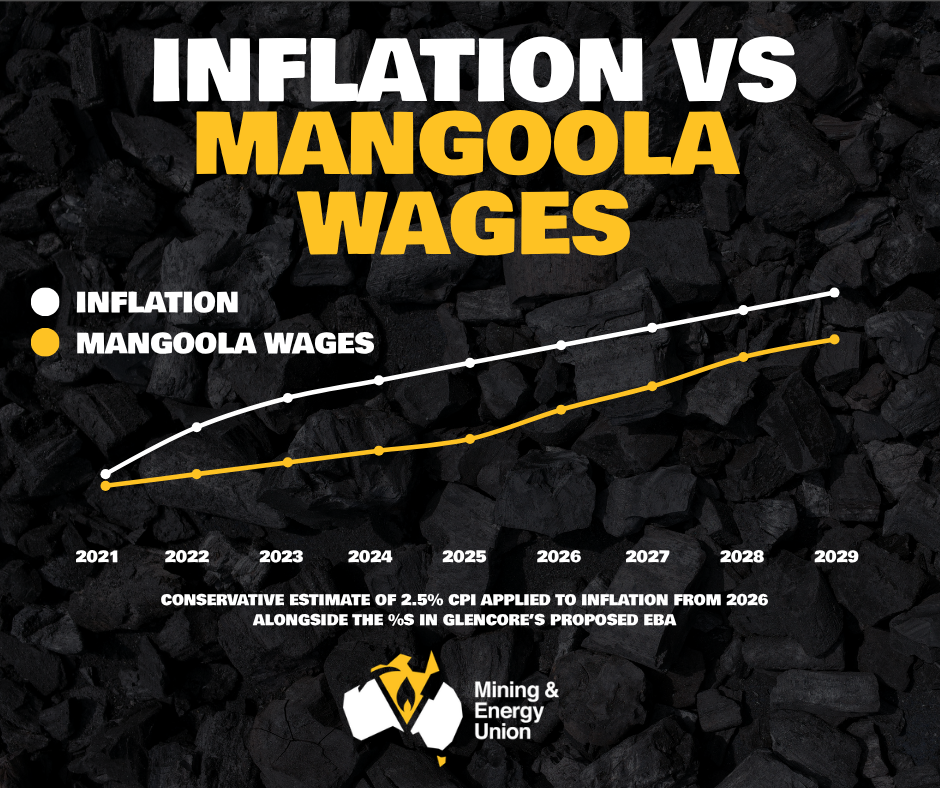
Since the 2021 agreement, Mangoola wage increases have been 2% per year. Over the same period, inflation has been significantly higher, meaning workers’ real wages — what pay can actually buy — have gone backwards.
Put simply, while pay under the EA rose slightly, the cost of living rose much faster. Groceries, fuel, housing and everyday expenses have all increased well beyond 2%. As a result, workers are effectively worse off now than they were at the start of the last agreement.
The proposed agreement offers increases of 4%, 4%, 4% and 3% over four years. While this may sound substantial, it does not restore the purchasing power lost during the previous agreement and is unlikely to keep pace with future inflation.
A Tiered Pay System Locks In Lower Wages
The proposal introduces a three-tier pay structure where workers performing the same job could receive different rates of pay.
Lower tiers would sit around 80–90 percent of the full rate, with the gap between the lowest and highest tier to reach about $41,000 within three years. New starters would be placed on the lowest tier, and workers transferring between sites could be pushed down regardless of experience.
Over time, this creates a permanently cheaper workforce and breaks the long-standing principle that workers doing the same job should receive the same pay.
Permanent Jobs Could Come Under Pressure
Lower-paid tiers make it easier to replace experienced permanent workers with cheaper labour over time. While “grandfathering” protections may apply at Mangoola, they may not follow workers if they move sites.
Fewer permanent roles mean less job security, fewer career pathways, and greater uncertainty for families who rely on stable employment in the region.
Weaker Redundancy Protection
Under the agreement, redundancy payments are calculated at base rate and based on rostered hours, rather than actual earnings. Rosters could potentially be reduced before redundancies occur, resulting in significantly smaller payouts.
This shifts puts risk onto employees, while the union’s proposed improvements to strengthen redundancy provisions were not accepted.
Allowances Are Not Guaranteed
The current $6,000 per year location allowance is not written into the proposed agreement. Without being locked into the EA, this payment could be removed at any time.
A proposed increase to the tool allowance was also rejected.
Bonus Payments Become More Uncertain
The TR1-ACE bonus system would remain in place and be expanded so that contractors would be included.
Contractors are not covered by the Mangoola Enterprise Agreement. Workers have raised concerns about contractors influencing bonus outcomes even though they are not party to the agreement itself.
Structural Changes Last Longer Than Pay Rises
Structural changes such as tiered pay systems can remain in place for many years once introduced.
Workers are concerned that accepting these changes now would permanently reshape conditions at the site and set a lower benchmark for future negotiations.
The Decision Matters for the Long Term
For many Mangoola workers and their families, this vote is about more than short-term pay increases. It is about long-term job security, fairness on site, and the future structure of the workforce.
Workers are encouraged to carefully consider how the proposal would affect not only current employees but also future generations entering the industry.
Vote NO
A NO vote keeps options open and maintains bargaining power. A YES vote locks the proposed terms in for the life of the agreement.
If you work at Mangoola, make sure you have the full picture before casting your vote. If you have any questions, contact the MEU.
No. It means the proposed deal is rejected and discussions continue. Workers can still negotiate for pay increases as part of a revised agreement.
The vote opens on March 31 and closes on April 1.
A NO vote does not shut down the site, cancel jobs, or end the process. It simply means the proposal was not accepted.
Voting NO signals that workers want changes to the offer, such as stronger protections, fairer pay arrangements, or different terms.
Ultimately, a NO vote keeps options open. A YES vote locks the proposed terms in for the life of the agreement.
Yes and workers fought to remove them. Tiered and seniority-based systems were abolished in the past because they were seen as unfair, divisive and a way to push wages down over time.
Many workers are concerned that reintroducing them could undo decades of progress.
Redundancy provisions determine what workers receive if jobs are cut. If payments are calculated at base rate or reduced hours rather than actual earnings, payouts may be significantly lower. Workers see this as a critical safety net during uncertain times.