
August 19, 2026
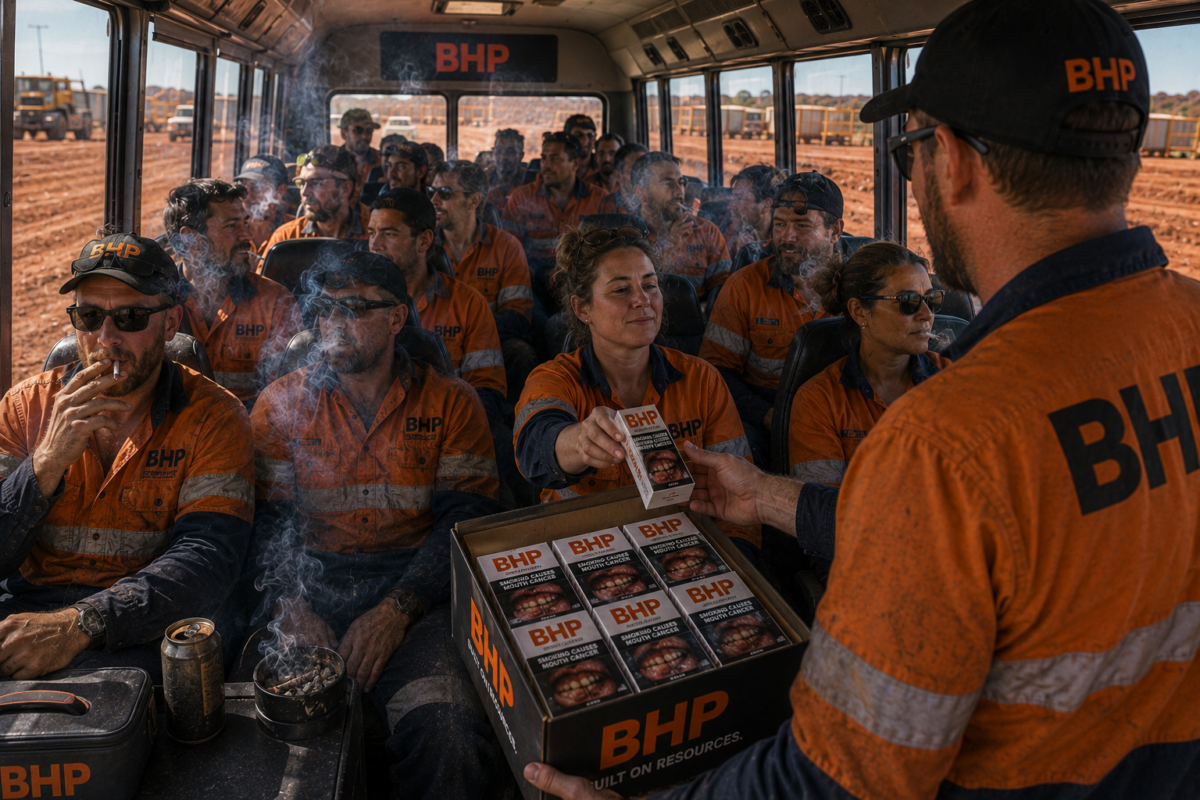
FIFO workers have spent more than three years fighting passive smoking at BHP accommodation camps, with cigarette smoke drifting into neighbouring dongas.
Mining and Energy Union members living in BHP’s Pilbara accommodation camps have repeatedly asked the company to introduce designated smoking areas away from workers’ rooms. Members have spent more than three years raising concerns about passive smoking at BHP accommodation camps, where company policies allow smoking immediately outside workers’ rooms.
BHP’s response is to point to their “village rules” which continue to permit smoking on verandas in front of rooms, provided smokers are “courteous” to nearby residents.
The approach stands in stark contrast to BHP’s rules governing smoking elsewhere in workers’ working lives.
BHP’s own operational non-smoking procedure recognises passive smoking as a health issue, restricts smoking where smoke could contaminate indoor areas and provides for designated smoking areas where available.
Their refusal to act on this issue rests on their insistence that the accomodation areas of the FIFO camps are designated as “private” rather than “public”. This of course ignores the obvious: BHP assign the accomodation, BHP requires employees to stay there, and BHP has a duty of care as a result.
Western Australian workplace safety laws also specifically recognise exposure to second-hand smoke as a workplace health issue.
BHP urged to introduce designated smoking areas
MEU Western Australian District Secretary Greg Busson said members could not understand why the risks associated with passive smoking were treated differently depending on which part of BHP’s operations they were in.
“This isn’t about smokers. It’s about everyone else,” Mr Busson said.
“BHP recognises passive smoking is a health risk while workers are on the job. But when those same workers finish a 12-hour shift and head back to camp, those protections go up in a puff of smoke.
“Workers aren’t asking BHP to ban smoking. They’re asking for a common sense, consistent approach. Designated smoking areas away from accommodation so they can sleep without someone else’s cigarette smoke drifting into their room.”
The problem members have raised is straightforward: allowing smoking immediately outside accommodation rooms puts cigarette smoke in unnecessarily close proximity to where other workers are living and sleeping.
Moving smoking away from the dongas and into designated areas would separate smoking from accommodation – an approach already adopted at camps operated by other major Pilbara miners including Fortescue and Hancock Iron Ore.
Workers have pursued issue for more than three years
Members have been raising concerns about second-hand smoke in BHP accommodation since 2022.
They have pursued the issue through supervisor reports, HSR hazard reporting, the dispute resolution procedure and repeated quarterly consultative meetings.
The matter has now also been reported to WorkSafe.
Despite those efforts, BHP has maintained its existing village policy.
The Union says BHP has relied on an arbitrary, and questionable distinction between “public” and “private” areas of its villages in refusing to change its approach.
Mr Busson said the distinction ignored the reality of FIFO life.
“These workers aren’t staying at camp because they decided to book themselves a holiday,” he said.
“They are there because they are rostered on to work for BHP.
“BHP has rules to protect workers from passive smoke at work. The law recognises second-hand smoke as a workplace health risk. Other major mining companies have designated smoking areas at their camps.
“Yet BHP is determined to defend a policy that allows smoking immediately outside another worker’s room.
“This isn’t a difficult safety issue to resolve. It’s a management decision.”
The MEU is calling on BHP to require smoking to occur in designated areas away from accommodation rooms.
“Workers have spent years asking BHP to fix this,” Mr Busson said.
“Every day BHP chooses not to act is another day workers are unnecessarily exposed to second-hand smoke in accommodation they are required to live in.”