
June 30, 2026
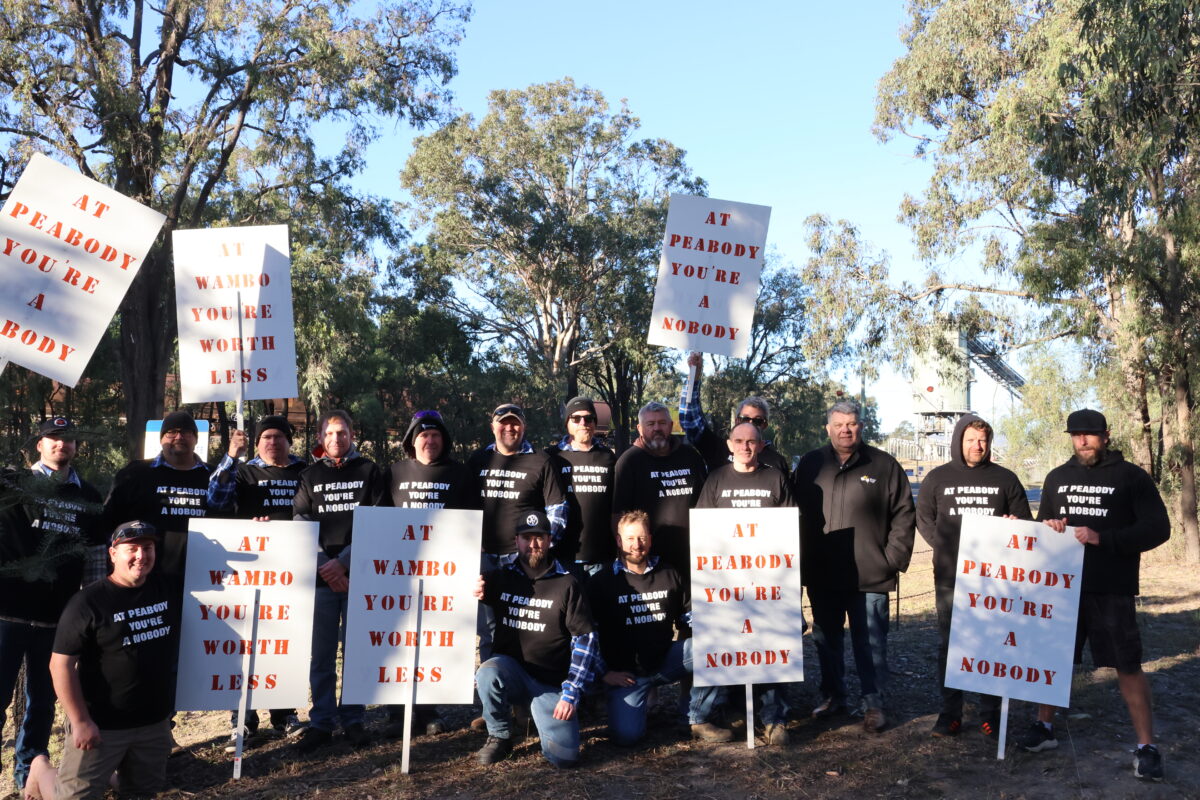
In June, we received word that 19 workers at Wambo Washery in the Hunter Valley had been locked out by their employer, Peabody. These workers are opposing a proposed agreement that would lock in pay rises well below the rate of inflation. They are now spending two weeks out the gate, not by choice, but as a punishment for standing up to their employer.
Lockouts have, unfortunately, become something of a routine occurrence throughout our industry. Recognising the collective strength of the MEU on site – and the willingness of coal mine workers to exercise their workplace rights in pursuit of a better agreement – the big mining bosses have settled on a strategy of ‘starving out’ workers who try to exercise their workplace rights through Protected Industrial Action.
The Law currently favours employers under the Fair Work Act, as employers can initiate “Employer Response Action” to retaliate against workers taking any form of Protected Industrial Action, including minor acts like changes to the regular performance of work, or short work stoppages.
Unlike Protected Industrial Action, where workers are required to apply for a Protected Action Ballot Order from the Fair Work Commission, undertake the Ballot process and return a majority, and then notify the employer of their intention on each and every occasion, the employer is only required to give notice of their Employer Response Action. In other words, while workers are required to undertake a painstaking and heavily scrutinised process in order to exercise their workplace rights, employers are able to respond swiftly and with very little oversight from judicial bodies.
Bosses are only required to notify workers of their intention to lock them out, and the lockout must be in response to Protected Industrial Action that has been or will be taken by workers. This leads to absurd escalations where employers lock out their workers for weeks in retaliation for a minimal disruption to work.
Employers are now factoring lockouts into their bargaining strategies. Well-resourced international mining companies are much better positioned to absorb any loss incurred from an extended lockout than a worker who was expecting their regular income. Extended lockouts have become so routine that that one mine worker on the NSW South Coast told
the MEU that he had been locked out by his employer while bargaining for every EA in his working career – five times in his twenty years of service.
The current laws also lead to protracted disputes that take a heavy toll on families and communities. Glencore’s lockout of Oaky North miners in 2017 stretched on for almost an entire year, denying hundreds of workers and their families a wage. The economic loss for the workers, their families and local community was immeasurable.
Glencore were comfortable taking this course because it turned the workers at Oaky North into an example for miners at their other operations considering going on strike. This has a chilling effect on workers, who have to consider the possibility that they too could end up locked out of work for weeks or months because they exercised their workplace rights.
We recognise that the industrial relations system must be balanced between the interest of workers and employers – but on this issue, the scale is tipped well and truly in favour of the bosses. Any future changes to the Fair Work Act should include new guardrails on lockouts to make sure they’re not being abused by employers. One option could be a proportionality test by the Fair Work Commission to make sure that any lockouts are in line with previous Protected Industrial Action and aren’t escalating the negotiations in a malicious way. This would rebalance the system, prevent lockout abuse, and level the playing field for future bargaining.

Glenn Power
General Secretary